

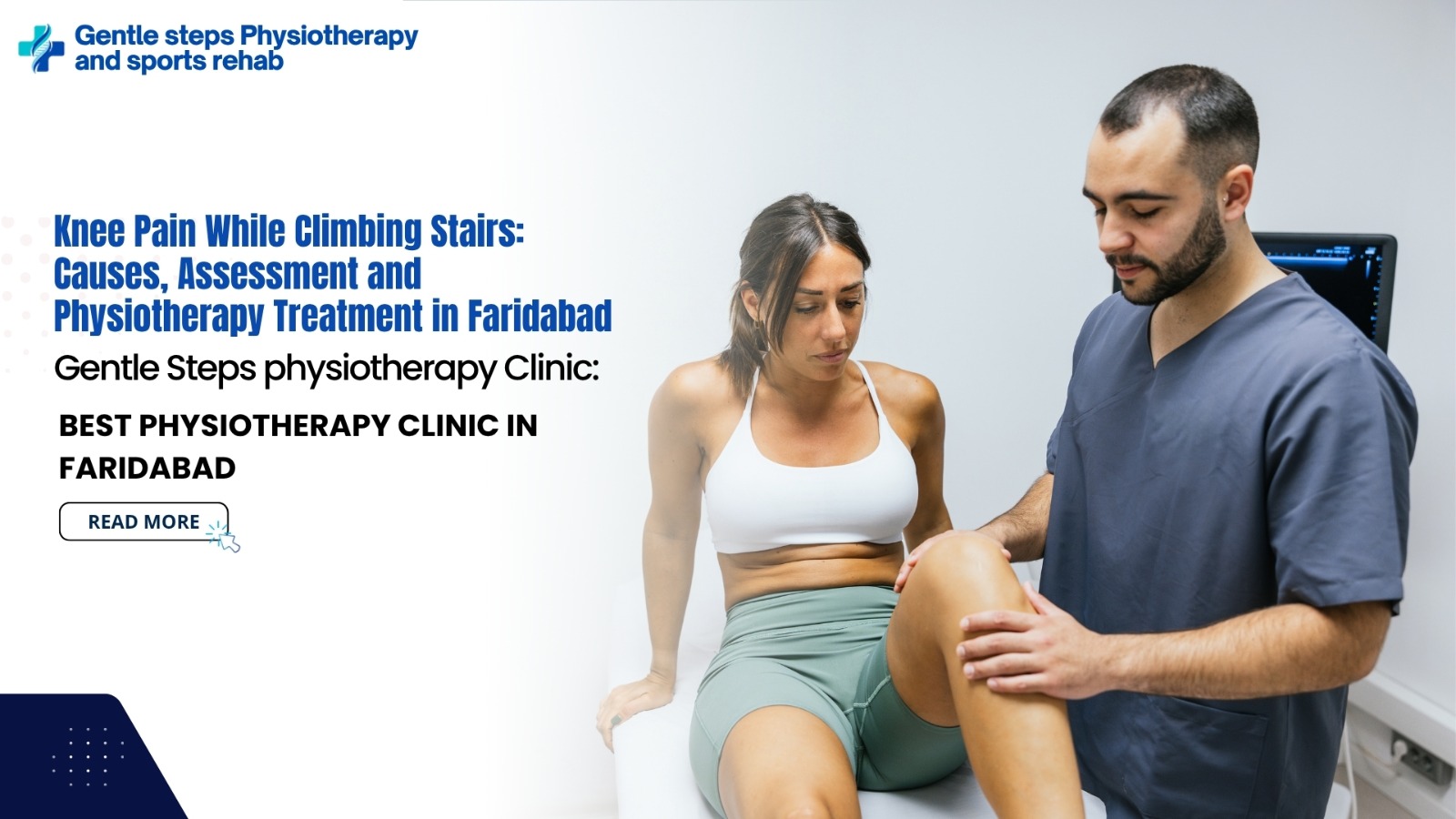
By Dr. Varun Saini | Gentle Steps Physiotherapy & Sports Rehab, Sector 87, Faridabad
Have you noticed that walking on a flat surface feels comfortable, but climbing stairs, stepping down, or getting up from a chair causes knee pain?
You are not alone. Many people experience knee pain during activities that require the knee to bend while supporting body weight. This can affect office workers, adults with knee arthritis, recreational runners, gym-goers and people recovering from knee injuries.
The important question is: Why does your knee hurt during certain movements but not others?
The answer may involve the kneecap, quadriceps strength, hip control, joint mobility, activity levels or an underlying knee condition. Identifying the reason is the first step towards an effective recovery plan.
At Gentle Steps Physiotherapy & Sports Rehab in Sector 87, Faridabad, rehabilitation focuses on assessing movement
, improving strength and helping patients return to everyday activities safely.Climbing stairs places different demands on your knee compared with walking on level ground. Your knee bends while your leg muscles control the movement and support your body weight.
Several conditions may contribute to pain.
Patellofemoral pain is commonly associated with pain around or behind the kneecap. It may become noticeable during stair climbing, squatting, running, jumping or standing after prolonged sitting.
The problem can be influenced by training loads, knee and hip strength, movement tolerance and other individual factors. Pain during stairs alone is not enough to confirm this diagnosis.
The quadriceps muscles at the front of the thigh help control knee movement and support activities such as standing up and descending stairs.
After an injury, surgery or a period of reduced activity, weakness may make these movements more difficult. A physiotherapist can assess muscle strength and determine whether strengthening is appropriate.
Osteoarthritis may cause knee pain, stiffness and difficulty with weight-bearing activities. Symptoms may be more noticeable after prolonged inactivity or during activities such as stair climbing.
However, knee pain does not automatically mean that you have arthritis
. Assessment should consider your symptoms, age, medical history and physical examination.A meniscus injury or ligament problem may cause pain during loaded knee movements. Swelling, locking, catching or a feeling that the knee is giving way may provide additional clues.
A sudden injury, particularly one accompanied by significant swelling or difficulty bearing weight, requires appropriate medical assessment.
The hip muscles help control the position of your thigh and knee during single-leg activities.
In some individuals, reduced hip strength or altered movement control may contribute to symptoms. However, these findings need to be assessed rather than assumed to be the cause of every patient's knee pain.
Walking on a flat surface and climbing stairs are different functional tasks.
During stair climbing and descending, the knee must manage changing joint angles, muscle demands and body-weight loading. A knee that tolerates ordinary walking may still be sensitive to these additional demands.
This is why a comprehensive physiotherapy assessment may examine:
The findings help guide an individual rehabilitation plan rather than relying on a single exercise or machine.
Effective treatment depends on the underlying condition, symptom severity and functional goals.
Temporarily modify activities that significantly aggravate your symptoms. This may mean reducing repeated stair climbing, avoiding painful deep squats or adjusting your exercise intensity.
Complete inactivity is not always necessary. The aim is to maintain suitable movement while allowing symptoms to settle.
Exercises may begin with gentle quadriceps contractions or straight-leg raises, depending on your assessment.
As strength and tolerance improve, your programme may progress to resistance exercises, sit-to-stand practice and functional step exercises.
Depending on your examination, your physiotherapist may include hip abductor and extensor strengthening, balance exercises and movement-control training.
The goal is to improve your ability to perform daily tasks with better strength and control.
If restricted movement contributes to your symptoms, an appropriate mobility programme may be included.
Functional training can gradually reintroduce activities such as stair climbing, controlled stepping and getting up from a chair.
Manual therapy or selected physical therapy modalities may sometimes help manage symptoms when clinically appropriate. They should complement a suitable exercise and rehabilitation programme rather than replace it.
Treatment choices should be based on assessment, evidence and the patient's response.
Do not begin a generic exercise programme without appropriate guidance if you have recently undergone surgery, sustained an acute injury or received specific weight-bearing restrictions.
Arrange an assessment if knee pain persists, repeatedly returns or interferes with walking, stair climbing, work or sport.
Seek urgent medical care if you have a severely painful or swollen knee, cannot bear weight after an injury, develop a hot and red knee with fever, or experience significant knee deformity.
At Gentle Steps Physiotherapy & Sports Rehab, we provide personalised physiotherapy and rehabilitation for knee pain, sports injuries, knee osteoarthritis and recovery after knee surgery.
Your treatment plan may include clinical assessment, progressive strengthening, movement training, balance exercises and functional rehabilitation according to your needs.
If you are searching for knee pain physiotherapy in Faridabad, a professional assessment can help identify appropriate next steps for your recovery.
Clinic: Gentle Steps Physiotherapy & Sports Rehab
Address: Shop No. 2, near SRS Royal Hills and Narayana School, Sector 87, Neharpar, Faridabad, Haryana 121007
Call: 9811571066
Website: Gentle Steps Physiotherapy & Sports Rehab
Contact the clinic to enquire about an appointment.
Descending stairs requires controlled lowering of your body while the knee is bent. Patellofemoral pain, muscle weakness, osteoarthritis and other conditions may contribute. An assessment is needed to identify the likely cause.
Not necessarily. Arthritis is one possible cause, but patellofemoral pain, tendon problems and other conditions can produce similar symptoms.
Physiotherapy can help many people improve strength, movement and function. Treatment depends on the diagnosis and may include progressive exercise, load management and functional training.
Not always. You may be able to continue comfortable walking while temporarily modifying activities that aggravate your symptoms. Significant pain, swelling or difficulty bearing weight needs medical assessment.
Recovery varies with the cause, severity, duration of symptoms and individual response to treatment. Your physiotherapist can monitor progress and adjust the programme as your function improves.
You can contact Gentle Steps Physiotherapy & Sports Rehab in Sector 87, Neharpar, Faridabad, on 9811571066 to enquire about an assessment.
Knee pain during stair climbing is a symptom, not a diagnosis. Understanding how your knee responds to loading, evaluating relevant muscle strength and identifying the underlying problem can help guide an appropriate recovery plan.
With individualised assessment, suitable exercise progression and consistent rehabilitation, many people can improve their ability to climb stairs and perform daily activities.
Gentle Steps Physiotherapy & Sports Rehab — helping you move better, recover stronger and return to daily life with confidence.
Learn More About Knee Pain Physiotherapy in Faridabad
Medical disclaimer: This article is for educational purposes only and does not replace an individual medical assessment or diagnosis.
