

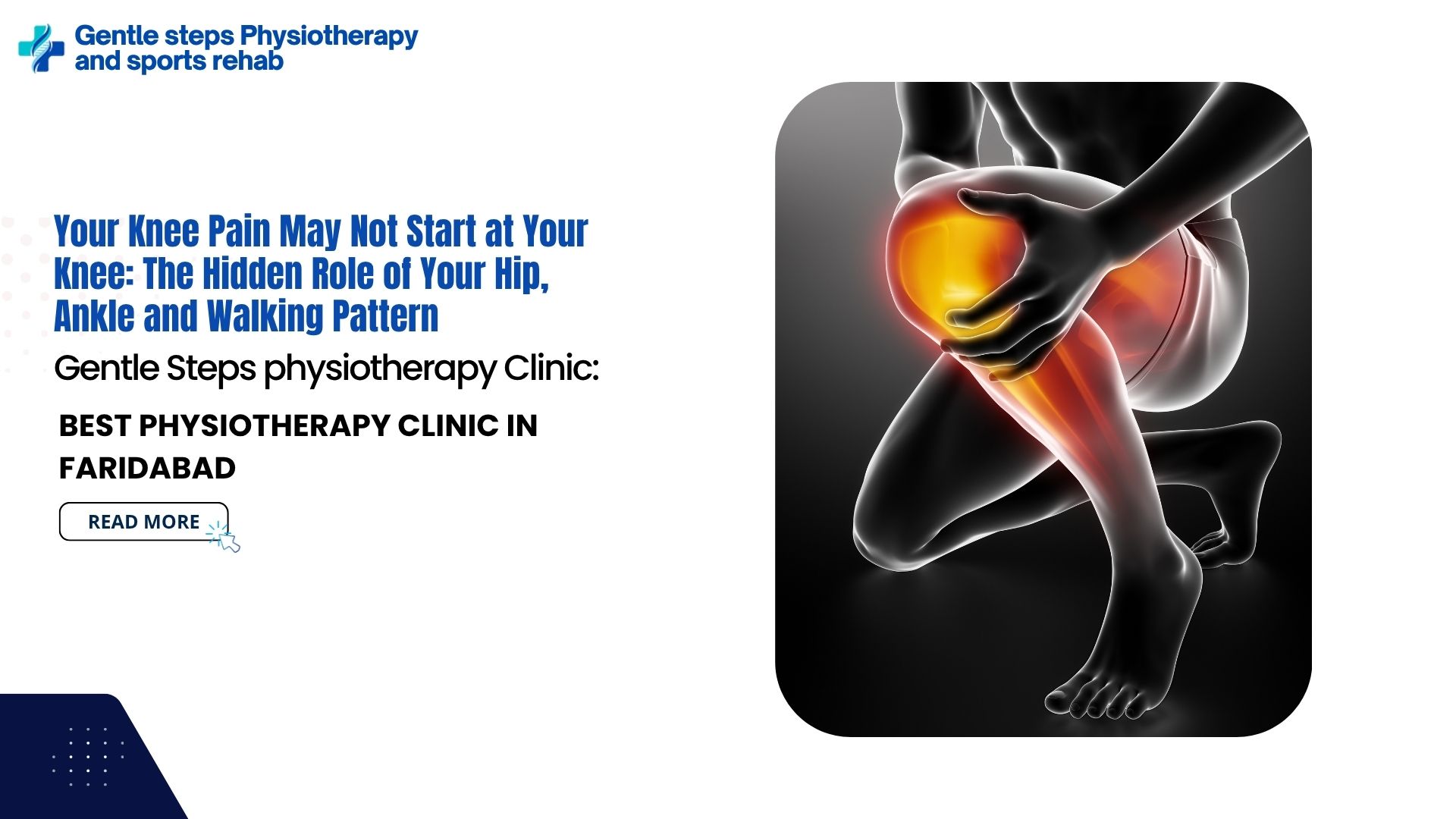
You feel pain around your knee while climbing stairs, walking, squatting or getting up from a chair. Your first thought is probably that something is wrong with your knee.
But have you ever considered that your hip movement, ankle mobility or walking pattern might also be contributing to the problem?
The human body works as a connected system. Your hip, knee and ankle work together to control movement, absorb forces and maintain balance. When one part of this system does not move or function as expected, the demands on other parts may change.
This does not mean that every knee problem originates somewhere else. However, examining the entire lower limb can help a physiotherapist understand why your knee hurts and develop a more individualised rehabilitation plan.
At Gentle Steps Physiotherapy & Sports Rehab, Faridabad, knee rehabilitation can include assessment of knee function
, hip strength, ankle mobility, balance and walking mechanics to identify factors that may be contributing to your symptoms.Your hip muscles play an important role in controlling the position of your thigh and knee during walking, running, landing and squatting.
The gluteal muscles, particularly the gluteus medius and gluteus maximus, help control pelvic stability and hip movement.
When hip strength or motor control is insufficient for a particular activity, a person may demonstrate increased inward movement of the thigh and knee during tasks such as single-leg squats, stair climbing or landing.
In some people, these movement patterns may contribute to knee symptoms, especially patellofemoral pain, commonly described as pain around or behind the kneecap.
These signs do not confirm that your hip is the cause of your knee pain. A physiotherapist should assess your symptoms, strength, movement and other possible causes.
Depending on your assessment, rehabilitation may include gluteal strengthening, controlled squats, step-down exercises, balance training and movement retraining.
The aim is to improve your ability to control movement during the activities that matter to you.
Your ankle needs sufficient mobility to allow your shin to move forward over your foot during activities such as walking, squatting and climbing stairs.
One important movement is ankle dorsiflexion, which brings the top of your foot closer to your shin.
If ankle dorsiflexion is restricted, you may compensate by lifting your heel early, turning your foot outward or changing the way you squat. These compensations can alter movement throughout the lower limb.
However, restricted ankle mobility does not automatically mean that it is responsible for your knee pain. The relationship depends on the individual, the activity and the underlying condition.
Your physiotherapist may assess ankle range of motion, calf flexibility
, foot mechanics and lower-limb strength.Treatment may include calf stretching, ankle mobility drills, progressive calf strengthening and task-specific movement exercises when appropriate.
Walking looks simple, but each step involves coordinated movement at the hip, knee and ankle.
Your walking pattern may change because of pain, weakness, stiffness, previous injury, footwear, fatigue or other factors.
For example, someone recovering from knee surgery may spend less time standing on the operated leg. This can be a protective response to pain or reduced confidence. If the pattern persists, it may affect walking efficiency and place different demands on the opposite leg.
Other features a physiotherapist may assess include:
Important: There is no single perfect walking pattern for everyone. A gait assessment should consider your symptoms, physical capacity, diagnosis and goals rather than forcing every patient to walk in exactly the same way.
Rest can be useful during an acute flare-up or following an injury. However, prolonged avoidance of movement may also reduce strength, endurance and confidence.
Knee symptoms can persist for several reasons, including osteoarthritis, patellofemoral pain, tendon problems, previous injuries or changes in activity load.
If the pain repeatedly returns when you resume walking, exercising or climbing stairs, it may be worth investigating the underlying condition and your current capacity for activity.
A comprehensive assessment can help distinguish between problems that respond to progressive exercise and those that need medical investigation or a different treatment approach.
Do not assume that hip weakness or ankle stiffness is the cause without an appropriate assessment.
You can observe how comfortably you perform a few everyday movements. These checks are not diagnostic tests and should not be used to rule out an injury.
Sit on a stable chair and stand up slowly, if comfortable. Notice whether one side feels weaker or more painful.
Hold a sturdy support and perform a shallow squat only if it is comfortable. Observe whether your heels remain down and whether the movement feels controlled.
Walk a short distance on a level surface. Notice whether you limp, avoid one leg or experience increasing pain.
Stop if the movement causes significant pain, instability or worsening symptoms. Do not attempt single-leg hops or deep squats to test an already painful knee.
If you have substantial swelling, recent trauma, difficulty bearing weight or a locked knee, seek medical assessment rather than performing home tests.
At Gentle Steps Physiotherapy & Sports Rehab, an individualised knee rehabilitation assessment may consider:
Not every patient needs every test. The assessment should be tailored to the person's presentation.
Treatment depends on the underlying diagnosis and the factors identified during assessment. A rehabilitation plan may include:
Hands-on therapy or other treatment modalities may be used as appropriate, but they should complement—not automatically replace—active rehabilitation.
There is no single exercise or machine that is right for every type of knee pain.
Hip weakness or reduced movement control may contribute to knee symptoms in some people, particularly those with patellofemoral pain. However, knee pain can have many causes, so an individual assessment is important.
Restricted ankle dorsiflexion can alter squat mechanics and some lower-limb movement patterns. Whether this contributes to your knee pain depends on your condition and how you move.
No. An MRI is not necessary for every case. The decision depends on your history, clinical examination, suspected diagnosis and whether imaging would change management. A clinician can advise you when further investigation is appropriate.
Recovery varies according to the underlying condition, symptom duration, severity, general health and treatment goals. Some problems improve over weeks, while post-operative rehabilitation and persistent conditions may require a longer programme.
You can contact Gentle Steps Physiotherapy & Sports Rehab in Sector 87, Neharpar, Faridabad, for information about a physiotherapy assessment and an individualised rehabilitation plan.
Knee pain deserves more than a one-size-fits-all exercise programme. Hip strength, ankle mobility, walking mechanics and overall activity levels can all be relevant—but the knee itself must also be examined.
The goal is not simply to identify where it hurts. It is to understand the condition, assess the factors that may be contributing to it and help you return to daily activities safely and confidently.
Contact Gentle Steps Physiotherapy & Sports Rehab for information about knee pain physiotherapy and rehabilitation in Faridabad.
Location: Sector 87, Neharpar, Faridabad, Haryana 121007
Call: 9811571066
Visit Gentle Steps Physiotherapy & Sports Rehab
Book an assessment to discuss your symptoms and rehabilitation goals with a physiotherapy professional.
Medical note: This article provides general educational information and does not replace individual medical assessment or diagnosis.
