

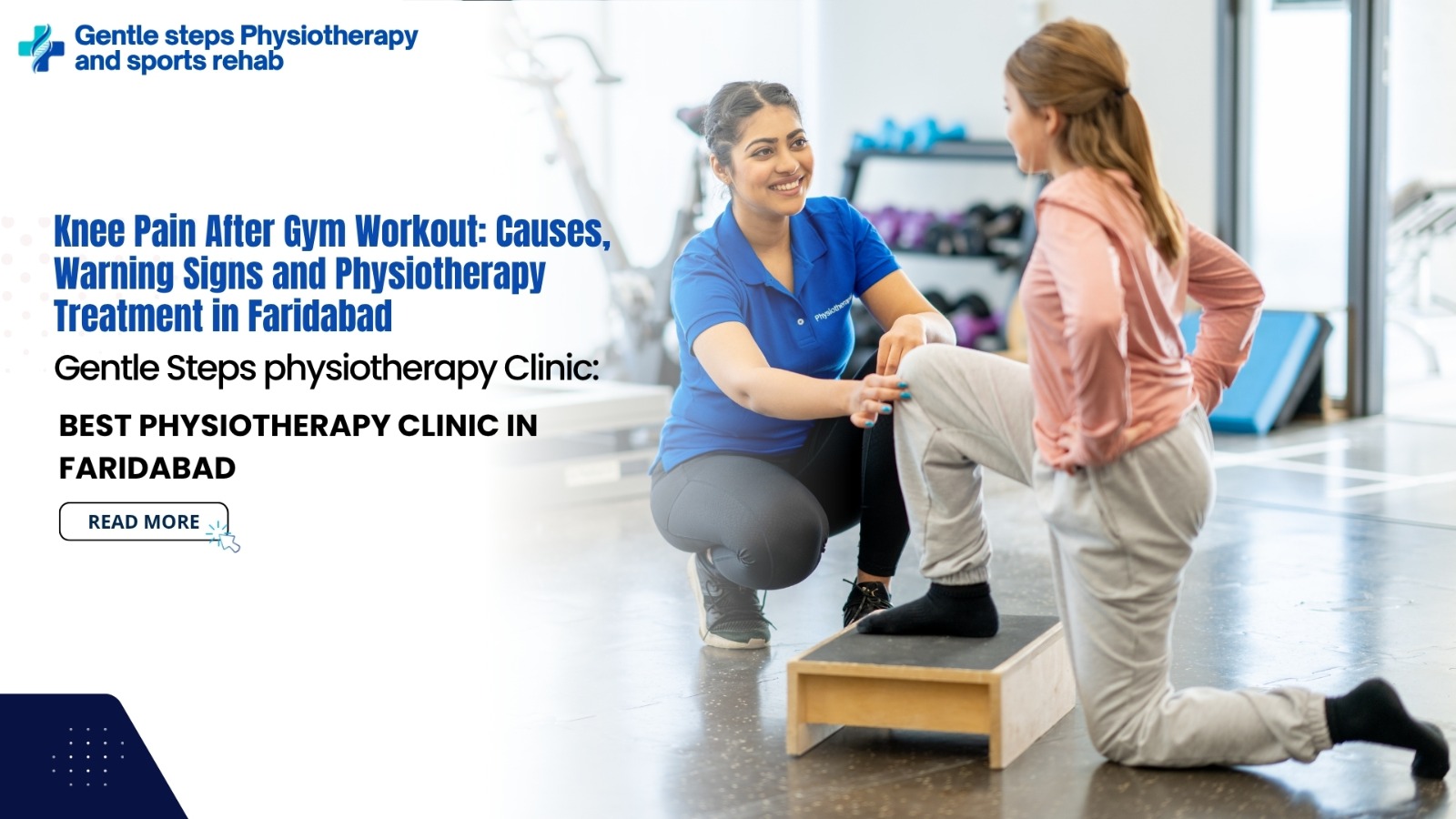
Are you experiencing knee pain after a gym workout?
Going to the gym is an excellent way to improve strength, fitness and overall health.
However, sometimes people experience knee pain after exercises such as squats, lunges, leg presses, running or jumping.Many gym enthusiasts ignore this discomfort and continue exercising. Others stop all physical activity because they are afraid of damaging their knees.
But knee pain after exercise does not always mean a serious injury. Understanding the cause and modifying your workout appropriately can help you recover safely.
At Gentle Steps Physiotherapy & Sports Rehab, Sector 87, Faridabad, we provide personalised physiotherapy and sports rehabilitation for people experiencing gym-related injuries and knee problems.
Several factors can contribute to knee pain during or after exercise.
Increasing weights, repetitions or workout duration too quickly can overload the knee and surrounding tissues.
Poor control during squats, lunges and leg presses may increase stress on the knee.
Pain around or behind the kneecap may develop during squatting, stair climbing, running or prolonged sitting.
Repeated jumping, running and heavy loading can irritate the patellar tendon, causing pain below the kneecap.
Reduced strength or coordination around the hip, thigh and lower leg may affect how the knee handles exercise loads.
People with previous ligament, meniscus or kneecap injuries may experience symptoms when returning to intense workouts.
Some exercises that may aggravate knee symptoms include:
These exercises are not necessarily harmful. Their suitability depends on your symptoms, technique, strength and current capacity.
Understanding the difference is important.
If you experience significant swelling, inability to bear weight, a locked knee or severe pain after an injury, seek prompt medical assessment.
A physiotherapist may recommend suitable exercises depending on the underlying problem and your assessment.
Helps improve the strength of the muscles at the front of your thigh.
Can help develop quadriceps control when appropriate.
Exercises such as bridges and hip abduction can improve hip muscle strength.
Helps develop functional lower-limb strength.
Can gradually improve strength and control during stair-related activities.
Start with an appropriate level of resistance and range of movement. Not every exercise is suitable for every knee condition.
Physiotherapy focuses on identifying the factors contributing to your symptoms and improving your ability to tolerate physical activity.
At Gentle Steps Physiotherapy & Sports Rehab, rehabilitation may include:
Treatment is individualised according to your condition and recovery goals.
Consider professional assessment if:
Early assessment can help identify the problem and guide appropriate rehabilitation.
If you are experiencing knee pain after gym workouts, don’t simply ignore recurring symptoms or continue pushing through pain.
At Gentle Steps Physiotherapy & Sports Rehab, Dr. Varun Saini (BPT, MPT), Senior Sports Physiotherapist, provides personalised orthopaedic and sports rehabilitation.
Our rehabilitation services include:
Clinic: Gentle Steps Physiotherapy & Sports Rehab
Location: Sector 87, Neharpar, Faridabad, Haryana 121007
Phone: 9811571066
Website: drvarunphysiotherapy.in
Not necessarily. You may need to modify exercises, reduce loading or temporarily avoid movements that aggravate your symptoms.
Squats do not automatically damage your knees. Appropriate technique, load management and gradual progression are important.
Yes. Physiotherapy can help identify contributing factors and develop an individualised strengthening and rehabilitation programme.
Recovery depends on the underlying condition, severity, training demands and response to rehabilitation. There is no single recovery timeline for everyone.
You can visit Gentle Steps Physiotherapy & Sports Rehab, Sector 87, Faridabad, for an individualised assessment and rehabilitation plan.
This article is for educational purposes and does not replace an individual clinical assessment.
