

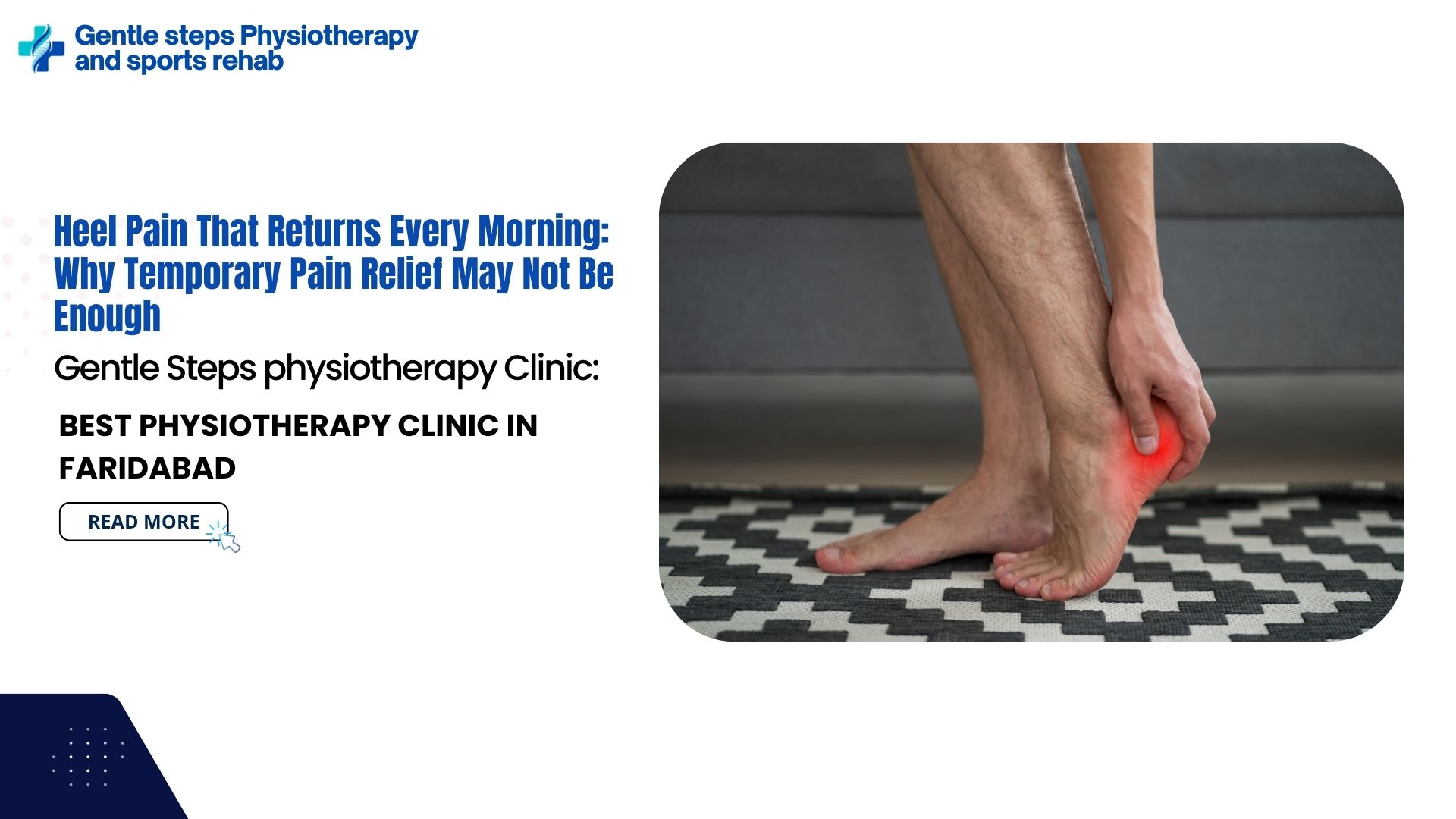
Have you ever woken up, placed your feet on the floor and felt a sharp pain under your heel? Perhaps the pain improves after walking for a few minutes, only to return after sitting for a long time or standing throughout the day.
This pattern is commonly associated with plantar fasciitis, a condition affecting the thick band of connective tissue called the plantar fascia that supports the arch of your foot.
Many people focus only on reducing pain. However, if the factors contributing to the problem remain unchanged, symptoms may persist or return.
At Gentle Steps Physiotherapy & Sports Rehab, Faridabad, our approach to heel pain focuses on identifying contributing factors, managing physical load, improving calf and foot strength, and selecting appropriate treatment options based on individual assessment.
The plantar fascia is a strong band of tissue running along the bottom of your foot, connecting the heel bone to the front of the foot.
It helps support the arch and manages forces during standing, walking, running and jumping.
When this tissue becomes painful, everyday activities such as getting out of bed, walking barefoot or standing for prolonged periods may become uncomfortable.
Common symptoms include:
Although plantar fasciopathy is a common cause of this pattern, not every case of heel pain is plantar fasciitis. A proper assessment is important, especially when symptoms are unusual or persistent.
Pain relief can be helpful, but reducing symptoms does not always restore the foot's ability to tolerate everyday physical demands.
Several factors may contribute to recurring heel pain.
Long working hours on your feet, sudden increases in walking, running or sports training, and inadequate recovery between demanding activities can aggravate symptoms.
For example, someone who spends eight hours standing at work may experience increasing heel discomfort even without participating in sports.
The solution is not necessarily complete rest. Instead, the aim is to adjust the amount and type of activity to a level the foot can tolerate while gradually rebuilding capacity.
The calf muscles contribute to ankle movement and help control forces during walking and running.
Reduced ankle mobility or insufficient calf capacity may contribute to increased demands on the foot in some individuals.
However, tight calf muscles are not present in every case, and stretching alone is not a complete treatment plan.
The small muscles within the foot help control the arch and support the foot during weight-bearing activities.
If the foot is not adequately prepared for the demands placed upon it, strengthening exercises may form an important part of rehabilitation.
Walking barefoot on hard floors, wearing worn-out footwear or suddenly changing to minimalist shoes may aggravate symptoms in some people.
Footwear needs vary according to comfort, activity, foot structure and individual response.
A common mistake is reducing pain for a few days and immediately returning to the previous level of walking, standing or exercise.
Symptoms may return because the foot has not yet regained sufficient load tolerance.
Load management means finding the right balance between activity and recovery.
Consider the following strategies:
A useful principle is to avoid repeatedly pushing through worsening pain. If symptoms increase and remain aggravated the next morning, reduce the previous activity dose and progress more gradually.
Calf stretching may help when ankle mobility is restricted.
A bent-knee calf stretch can also be used to target the deeper calf muscle.
Avoid forcing the stretch or repeatedly reproducing sharp heel pain. Your physiotherapist can modify the exercise according to your symptoms and mobility.
Progressive strengthening helps improve the capacity of the calf and foot to tolerate everyday loading.
A starting option is 2 sets of 8–12 repetitions, provided this does not significantly aggravate symptoms. Progression may involve more repetitions, single-leg loading or additional resistance.
The best starting level depends on pain severity, balance and current strength.
The purpose is to activate the foot muscles without gripping the floor with the toes.
As control improves, your physiotherapist may progress you to standing exercises and more demanding weight-bearing activities.
Footwear can help reduce discomfort while the foot's load tolerance improves.
Consider:
Orthoses and insoles may provide short-term relief for some people, but they are not a guaranteed cure. They should complement a broader rehabilitation plan rather than replace strengthening and load management.
Extracorporeal shockwave therapy (ESWT) is a non-invasive treatment that delivers acoustic pressure waves to a targeted area.
It may be considered for persistent plantar heel pain when an appropriate programme of education, activity modification and exercise has not provided sufficient improvement.
At Gentle Steps Physiotherapy & Sports Rehab, Faridabad, shockwave therapy may be considered as part of an individualized rehabilitation programme following clinical assessment.
Depending on the patient and treatment protocol, shockwave therapy may:
Research suggests that some patients benefit, but results vary according to the condition, treatment protocol and individual circumstances.
It is important to understand that shockwave therapy:
A clinician should first confirm that the symptoms are consistent with plantar heel pain and consider other causes before recommending treatment.
The key message: Shockwave therapy may help manage symptoms, but lasting improvement generally requires attention to the factors that determine how well the foot tolerates load.
Consider an assessment if:
Seek prompt medical assessment if the pain follows a significant injury, you cannot bear weight, the heel is hot or markedly swollen, you have fever, or you experience numbness or other unusual symptoms. Persistent night pain or unexplained worsening pain also warrants evaluation.
A physiotherapy assessment may include a review of your symptoms
, walking and activity patterns, ankle mobility, calf strength, foot function and relevant medical history.Other conditions, including a calcaneal stress injury, nerve irritation or heel fat-pad problems, may require consideration depending on the presentation.
Heel pain treatment should be based on more than the location of your pain.
At Gentle Steps Physiotherapy & Sports Rehab, our rehabilitation approach may include:
The objective is to help you return to comfortable walking, standing, exercise and everyday activities with a structured plan tailored to your needs.
The first steps after sleep or prolonged rest often provoke pain in people with plantar fasciopathy. The tissue is exposed to loading after a period of rest, and the initial steps can be particularly uncomfortable.
Many cases improve with time, appropriate activity modification and a suitable home exercise programme. Physiotherapy can help guide rehabilitation, address contributing factors and determine whether additional treatment is appropriate.
Recovery varies. Some people improve over several weeks, while persistent cases may take months. Duration depends on symptom severity, activity demands, health factors and consistency with an appropriate treatment plan.
Neither is universally better for every patient. Progressive exercise and load management are important parts of conservative care. Shockwave therapy may be considered as an additional option for selected patients with persistent symptoms.
Usually, complete rest is not necessary. The goal is to reduce activities that significantly aggravate symptoms while maintaining tolerable movement and gradually rebuilding capacity.
A qualified physiotherapist or appropriate medical clinician can assess your symptoms and recommend a treatment plan. Seek medical evaluation if symptoms suggest an injury or another condition rather than straightforward plantar heel pain.
If recurring morning heel pain is affecting your routine, do not focus only on temporary relief. Find out what may be contributing to the problem and how to progressively restore your foot's capacity.
Gentle Steps Physiotherapy & Sports Rehab
Senior Sports Physiotherapist: Dr. Varun Saini
Location: Sector 87, Neharpar, Faridabad, Haryana 121007
Phone: 9811571066
Visit Gentle Steps Physiotherapy & Sports Rehab
Contact the clinic to discuss an assessment and individualized rehabilitation options.
Take the first step towards comfortable walking by arranging a heel pain assessment.
Educational disclaimer: This article provides general information and is not a substitute for an individual clinical assessment or medical advice.
