

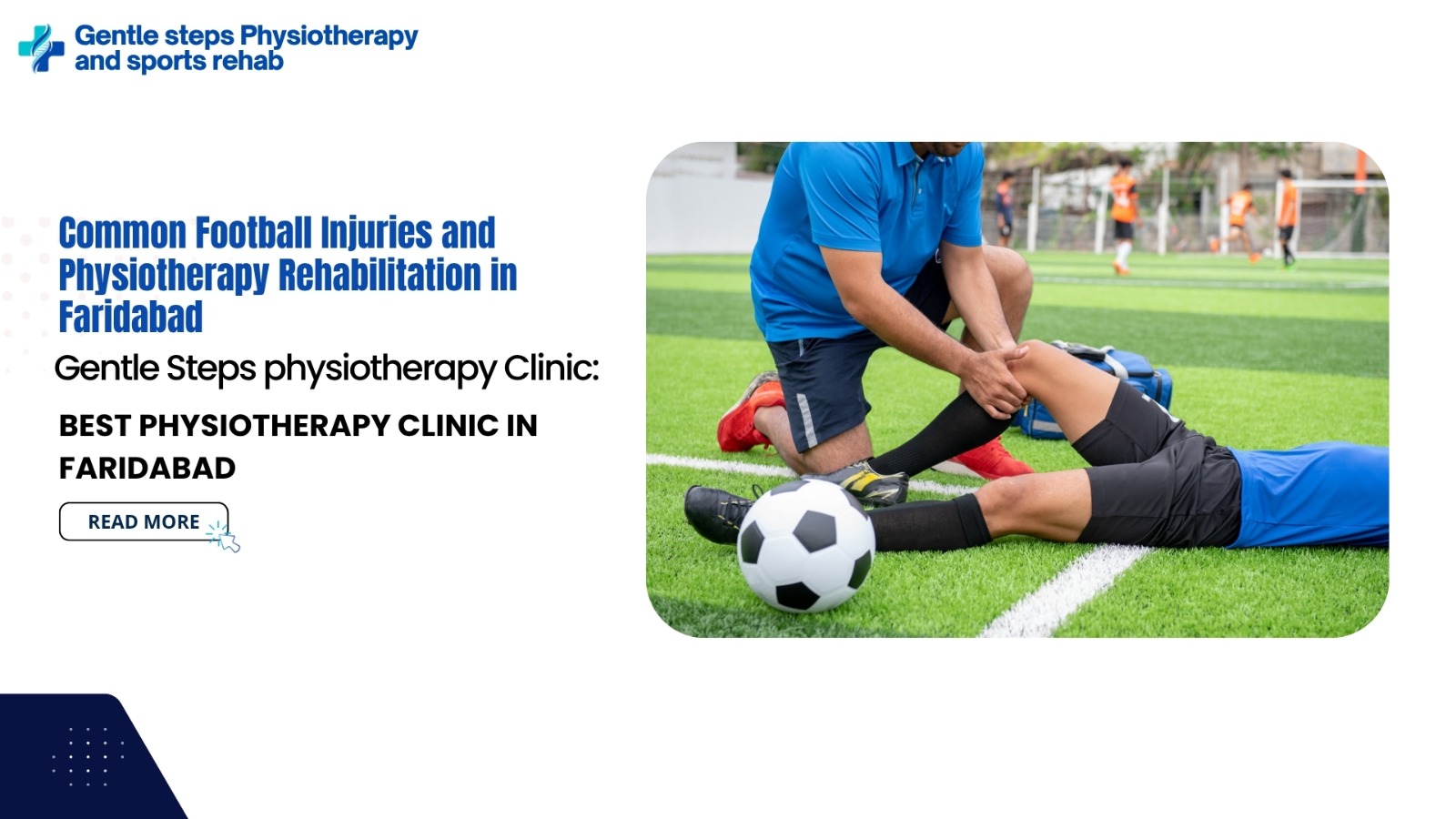
Football is a high-intensity sport involving running, sprinting, sudden stops, jumping, tackling and rapid changes in direction. These movements place significant stress on the muscles, joints and ligaments.
Because of this, football players can experience injuries ranging from minor muscle strains to significant ligament injuries.
At Gentle Steps Physiotherapy & Sports Rehab in Sector 87, Faridabad , sports physiotherapy focuses on helping players recover from injury, restore strength and movement, and progressively return to football.
Football injuries commonly affect the knee, ankle, thigh, groin and hamstring.
Some of the most common injuries include:
The severity of an injury can vary considerably. A proper assessment is important before deciding on a rehabilitation programme.
Hamstring injuries are particularly common in football because players frequently sprint and accelerate.
A hamstring strain may cause:
Rehabilitation usually progresses from symptom management to mobility, strengthening, running drills and eventually high-speed football-specific movements.
An ankle sprain can occur when the foot rolls or twists during running, landing or contact with another player.
Common symptoms include:
Physiotherapy may focus on restoring ankle movement, strength, balance and functional control.
Returning to football without adequate rehabilitation can increase the risk of recurrent ankle sprains.
The anterior cruciate ligament (ACL) helps provide stability to the knee. Football involves frequent pivoting, cutting and sudden changes of direction, which can place significant stress on the ACL.
An ACL injury may occur during:
Rehabilitation may involve restoring knee movement, reducing swelling, strengthening the quadriceps and hamstrings, improving balance and progressing towards running, agility and sport-specific training.
For players who undergo ACL reconstruction, rehabilitation is usually a longer and highly structured process.
Football can place considerable load on the knee. Twisting movements and contact can contribute to meniscus or other knee injuries.
Symptoms may include:
The appropriate rehabilitation plan depends on the diagnosis and severity of the injury.
Groin pain is common in sports involving rapid acceleration, kicking and changes in direction.
Football players may develop groin pain because of:
Rehabilitation may include progressive strengthening of the hip and surrounding muscles, mobility work and gradual return to running and kicking activities.
The quadriceps and calf muscles work heavily during sprinting, kicking and jumping.
A muscle strain can occur when the muscle is exposed to a load beyond its current capacity.
Treatment and rehabilitation may involve:
The aim is not simply to make the pain disappear but to restore the capacity required for football.
Sports physiotherapy can be an important part of football injury rehabilitation.
The physiotherapist assesses pain, movement, strength, flexibility, balance and functional limitations.
Appropriate treatment may be used to help manage pain and symptoms while the underlying problem is addressed.
Restricted joint or muscle mobility can affect movement mechanics. Appropriate mobility exercises may be incorporated into rehabilitation.
Progressive strengthening helps restore the capacity of the injured tissues and surrounding muscles.
Balance and movement-control exercises are particularly important after ankle and knee injuries.
Once appropriate, rehabilitation progresses towards jogging, running, acceleration and deceleration.
The final stages may include:
The exact progression should depend on the injury and the player’s recovery.
One of the biggest mistakes athletes make is returning to football as soon as their pain improves.
Pain reduction is only one part of recovery.
Before returning to full football activity, an athlete may need adequate:
A gradual return-to-play programme can help determine whether the player is ready for progressively higher levels of activity.
Injury prevention begins before the match.
Players can reduce injury risk by focusing on:
Players with a history of ACL, hamstring or ankle injuries may benefit from individualized injury-prevention programmes.
A physiotherapy assessment may be appropriate if you experience:
If there is severe pain, significant swelling, inability to bear weight, obvious deformity or suspicion of a major injury, prompt medical evaluation is recommended.
Gentle Steps Physiotherapy & Sports Rehab, located in Sector 87, Neharpar, Faridabad, provides physiotherapy and sports rehabilitation for athletes and active individuals.
Rehabilitation programmes may include treatment for:
Depending on the clinical requirement, the clinic also provides modalities such as Shockwave Therapy, Class 4 Laser Therapy, Tecar Therapy and Compression Therapy as part of an overall rehabilitation programme.
If a football injury is affecting your training, running or performance, an appropriate assessment can help identify the problem and develop a progressive rehabilitation plan.
Gentle Steps Physiotherapy & Sports Rehab
Near SRS Royall Hills, Near Narayana School, SRS Pearl, Sector 87, Neharpar, Faridabad, Haryana – 121007
Dr. Varun Saini
Senior Sports Physiotherapist
Phone: 9811571066
Website: drvarunphysiotherapy.in
This article is for general educational purposes and does not replace an individual clinical assessment.
