

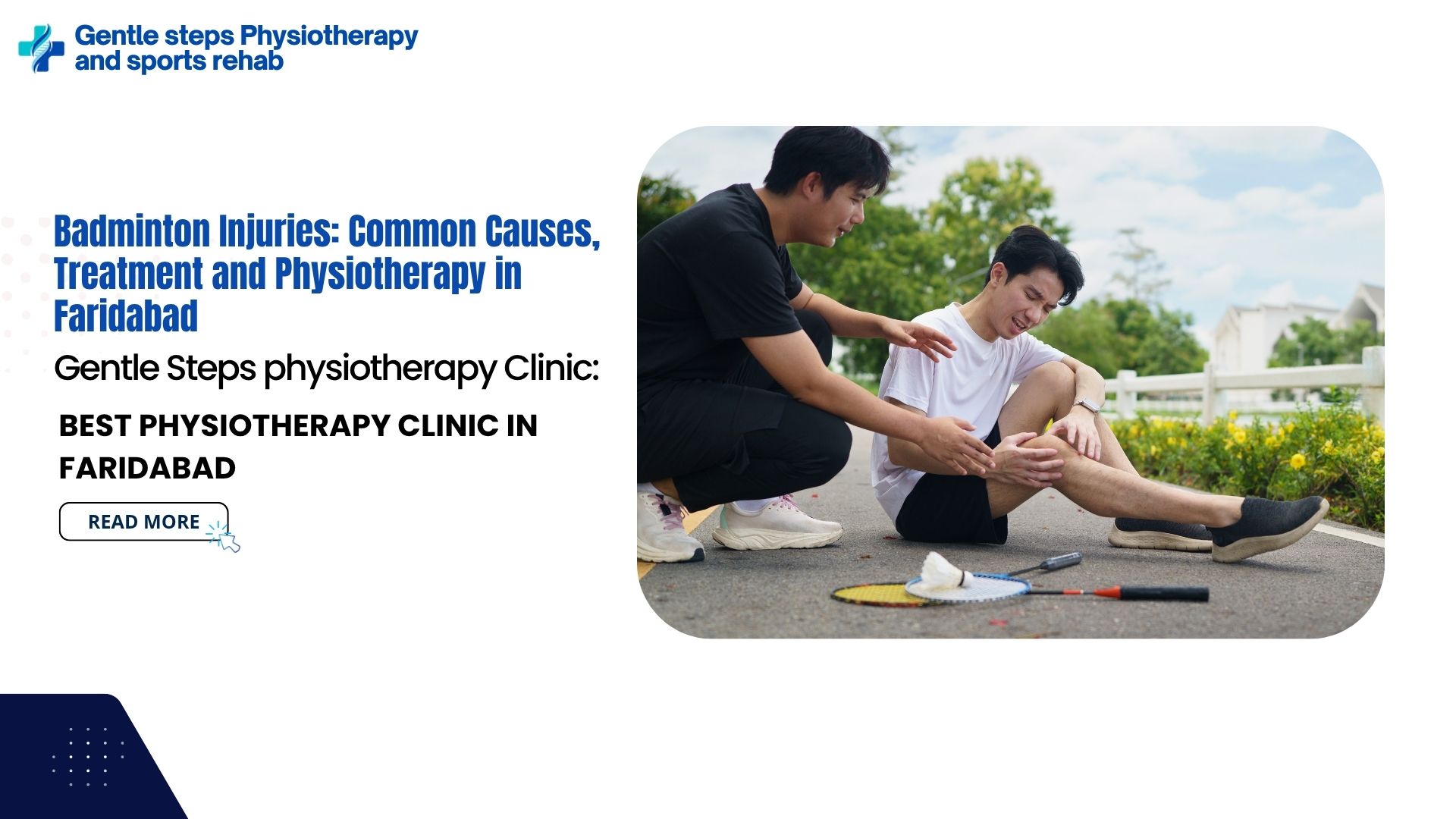
Badminton is a fast-paced sport that requires agility, speed, balance, jumping ability and rapid changes in direction. Although it offers excellent cardiovascular and physical benefits, repeated lunges, overhead strokes and sudden stops can place significant stress on the knees, ankles, shoulders and muscles.
Whether you play badminton professionally, participate in tournaments or play recreationally, understanding common badminton injuries can help you recognise symptoms early and seek appropriate treatment.
At Gentle Steps Physiotherapy & Sports Rehab, Sector 87, Faridabad, we provide individualised physiotherapy assessment and rehabilitation for sports-related injuries.
Ankle sprains can occur when a player lands awkwardly after a jump or changes direction quickly. Symptoms may include pain, swelling, tenderness and difficulty walking.
Physiotherapy rehabilitation may include:
Severe pain, deformity or an inability to bear weight requires prompt medical assessment to rule out a fracture.
Badminton involves frequent lunges, pivoting movements, jumps and rapid deceleration. These movements may contribute to knee pain or, in some circumstances, ligament injuries.
Possible symptoms include knee swelling, pain, instability and difficulty changing direction.
A physiotherapist may assess knee movement, strength, balance and functional control. Rehabilitation depends on the diagnosis and may include quadriceps strengthening, hip strengthening, neuromuscular training and progressive sport-specific exercises.
An ACL injury may require specialist assessment, and some patients need surgical reconstruction depending on their injury and activity goals.
The Achilles tendon helps transmit force from the calf muscles to the heel during running, jumping and push-off movements.
Repeated high-intensity training may contribute to Achilles tendon pain, particularly when training loads increase rapidly.
Treatment may involve load modification and a progressive calf-strengthening programme tailored to symptoms and tendon capacity.
A sudden popping sensation at the back of the ankle, especially with difficulty pushing off or standing on tiptoe, requires urgent medical assessment for a possible tendon rupture.
Repeated overhead smashes and clears can place considerable demands on the shoulder muscles and tendons.
Players may experience shoulder pain, weakness or discomfort during overhead movements.
Depending on the cause, rehabilitation may include shoulder mobility exercises, rotator cuff strengthening, scapular control training and gradual progression of overhead activity.
Persistent weakness or significant pain should be assessed to identify the underlying problem.
Despite its name, tennis elbow can affect badminton players. Repetitive gripping, wrist extension and racket movements may contribute to pain around the outer elbow.
Management may include modifying aggravating activities, progressive wrist and forearm strengthening, grip-load management and correction of relevant technique factors.
Sudden acceleration, lunging and rapid direction changes can overload the muscles of the thigh and calf.
Symptoms may include sudden pain, tenderness, weakness and difficulty running or jumping.
Rehabilitation commonly progresses from comfortable movement and appropriate loading to strengthening, running drills and sport-specific activities as tolerated.
Several factors may contribute to badminton injuries:
Injury causes vary from player to player, so an individual assessment is important.
The physiotherapist reviews the injury history, symptoms, range of motion, strength, balance and relevant functional movements. Additional medical assessment or imaging may be recommended when indicated.
The rehabilitation plan may include activity modification, appropriate loading and selected pain-management techniques according to the diagnosis.
Targeted exercises help improve the capacity of the affected muscles and joints. Exercises are selected according to the player’s symptoms, injury and recovery stage.
When appropriate, rehabilitation may include single-leg balance, controlled lunges, landing mechanics and gradual changes of direction.
Before returning to unrestricted play, the player should demonstrate adequate strength, balance, movement control and tolerance of badminton-specific drills. The progression should reflect the injury and individual recovery.
These strategies may reduce injury risk but cannot eliminate all injuries.
Consider professional assessment if you experience recurring knee or ankle pain, shoulder discomfort during smashes, persistent muscle tightness, reduced performance or difficulty returning to badminton after an injury.
Seek urgent medical assessment after a serious injury, suspected fracture, significant joint swelling, inability to bear weight or sudden loss of muscle or tendon function.
Gentle Steps Physiotherapy & Sports Rehab provides individualised assessment and rehabilitation for sports injuries, knee ligament injuries, muscle strains, ankle sprains and post-operative conditions.
Our rehabilitation approach focuses on restoring movement, improving strength and preparing patients for their functional and sporting goals.
Clinic: Gentle Steps Physiotherapy & Sports Rehab
Lead Physiotherapist: Dr Varun Saini
Address: Shop No. 2, near SRS Royal Hills, near Narayana School, SRS Pearl, Sector 87, Neharpar, Faridabad, Haryana 121007
Phone: 9811571066
Website: drvarunphysiotherapy.in
Contact the clinic to enquire about an assessment and an individualised rehabilitation plan.
Physiotherapy can help manage many sports injuries by addressing movement limitations, strength deficits, balance and progressive return to activity. Treatment depends on the specific diagnosis.
Recovery time varies depending on the injured tissue, severity, treatment and individual progress. Mild injuries may recover within weeks, while major ligament or tendon injuries can require several months or longer.
Continuing to play through significant pain, swelling or instability may worsen some injuries. Reduce aggravating activity and seek assessment to determine what is safe.
You can contact Gentle Steps Physiotherapy & Sports Rehab in Sector 87, Faridabad, to enquire about sports injury assessment and rehabilitation.
