

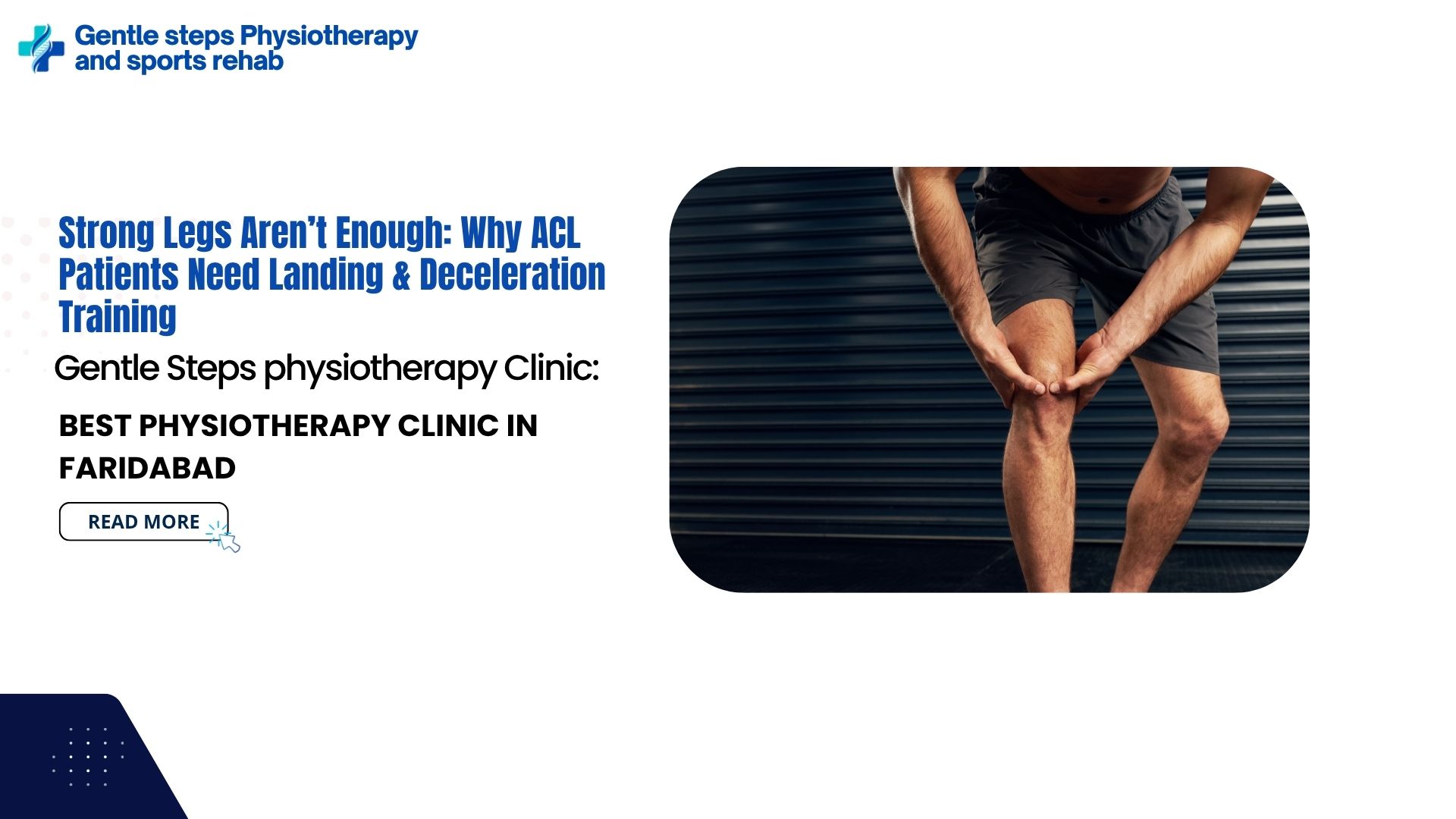
Many ACL rehabilitation programs focus heavily on strengthening the quadriceps, hamstrings and glute muscles. Strength is extremely important—but strong muscles alone do not automatically mean that an athlete is ready to return to sport.
An athlete may have good gym strength but still struggle when they have to land from a jump, stop suddenly, change direction, or control their body during a fast movement.
This is why landing and deceleration training are important components of modern ACL rehabilitation.
Deceleration is the ability to safely slow down or stop the body during movement.
Think about a footballer sprinting toward the ball and suddenly stopping, a basketball player landing after a rebound, or a cricketer changing direction while fielding.
These movements place significant demands on the knee and the muscles responsible for controlling it.
Rehabilitation should therefore prepare the athlete not only to produce force, but also to absorb and control force.
Landing is one of the most important skills in ACL rehabilitation.
Poor landing mechanics may involve:
A physiotherapist can assess these movement patterns and progressively train the athlete to develop better control.
Imagine an athlete who can perform heavy squats but cannot control a single-leg landing.
The problem isn’t necessarily a lack of strength.
The athlete may need better:
Sports require these abilities to work together at high speed.
Therefore, ACL rehabilitation should progressively move from controlled strengthening exercises toward functional and sport-specific movements.
Landing drills should not start with complex jumping exercises immediately.
A rehabilitation program may progress from:
Basic control → Double-leg landing → Single-leg landing → Jumping → Repeated jumps → Direction changes → Reactive drills → Sport-specific movements
The exact progression depends on the individual’s symptoms, strength, movement quality, surgical status and rehabilitation stage.
Athletes frequently train acceleration—running faster, jumping higher and becoming stronger.
But sports also demand the ability to brake.
Deceleration training may include:
The goal is to teach the body to absorb and control forces efficiently.
A football player doesn’t move like a swimmer.
A basketball player doesn’t move like a cyclist.
A cricketer may require repeated acceleration, stopping, rotation and sudden changes of direction.
Therefore, the final stages of ACL rehabilitation should gradually reproduce the demands of the athlete’s actual sport.
The closer rehabilitation becomes to real sporting movements, the better the athlete can prepare physically and mentally for returning to competition.
Before returning to sport, rehabilitation should consider more than simply asking:
“How much weight can you lift?”
Important areas can include:
A comprehensive assessment helps identify weaknesses that may not be obvious during routine gym exercises.
There is no single exercise or fixed week that is appropriate for every ACL patient.
These activities should be introduced progressively and according to rehabilitation criteria.
The intensity can gradually increase from low-load controlled movements to high-speed, reactive and sport-specific drills.
If pain, swelling or instability increases, the rehabilitation program should be reassessed rather than simply pushing through the symptoms.
The goal isn’t simply:
“My knee doesn’t hurt anymore.”
For an athlete, the goal is to regain the ability to:
Run → Stop → Jump → Land → Change direction → React → Perform confidently.
That requires progressive rehabilitation that combines strength, movement control and sport-specific training.
Strong legs are the foundation—but they are not the finish line.
After an ACL injury or reconstruction, athletes need to learn how to control their body while landing, stopping, changing direction and reacting to unpredictable situations.
A well-designed ACL rehabilitation program should therefore progress from strength training to movement training and finally to sport-specific performance.
If you are recovering from ACL reconstruction or preparing to return to sport, a sports physiotherapy assessment can help identify the areas that still need improvement.
At Gentle Steps Physiotherapy & Sports Rehab, rehabilitation focuses on progressive recovery, movement quality, strength, coordination, and preparation for a safe return to sports and daily activities.
Our approach may include:
If you are recovering from ACL reconstruction, dealing with an ACL injury, or preparing to return to sports, professional rehabilitation can help identify the areas that still need improvement.
Gentle Steps Physiotherapy & Sports Rehab
Sector 87, Neharpar, Faridabad
Sports Injury Rehabilitation | ACL Rehabilitation | Return-to-Sport Training
